Crew notebook
The Tire Notebook After a Short-Track Practice Run
Published August 30, 2026
A pressure number without its corner, timing, track condition and driver comment cannot explain the next change. Record one complete sequence before cooling erases the evidence.
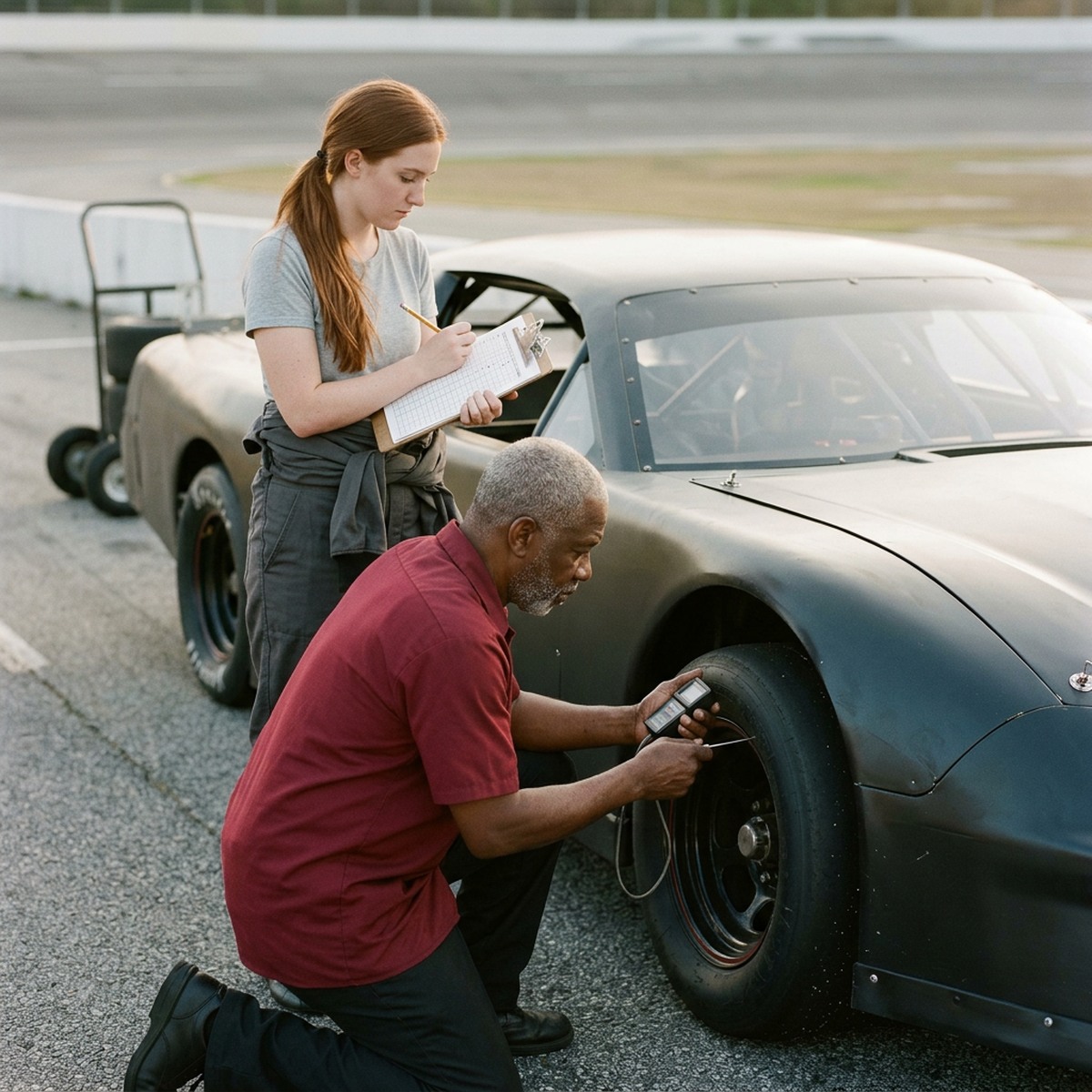
The car rolls to its pit spot, the engine shuts down and several clocks begin at once. Tire pressure starts moving as the assembly cools. Surface temperature changes. The driver's sharpest description of the last laps begins to soften into a general impression. A useful tire notebook captures that short interval in the same order after every run.
Hoosier's official asphalt-oval guidance explains why pressure gain, tire size and bleeder settings have to be read as a system: pressure can fall during a caution or cool-down, and adjusting a hot tire can change the later result. The practical lesson is not to copy a pressure from another car. It is to record when and how each number was taken, then follow the tire maker, series and track requirements for that exact application.
This notebook is not a universal setup sheet. It is a disciplined record of one car, one tire program and one session. Its value comes from comparison: the same gauge, the same measuring order and enough context to distinguish a real trend from a late reading, a different lap count or a changed track.
Keep the measuring order fixed
The photograph shows the useful division of work. One crew member measures the hot right-front tread while a second records the result. The car is stationary on all four wheels, the hood is closed and the reading is taken before unrelated jobs crowd the wheel. The pair can move around the car in a pre-agreed order so every run has a comparable time gap between pit entry and each corner.
Write the pit-in time or start a simple elapsed timer. Identify the corner before calling the number. If the team collects tread temperatures, keep the inner, middle and outer order consistent and use the same type of instrument. Hoosier's published RCES setup guidance notes that a needle probe and an infrared surface reading do not produce interchangeable evidence. That document covers a different racing application, so its target temperature range should not be imported into a short-track program; the measurement-method warning is the point worth carrying into the notebook.
Do not let speed turn the process into unsafe choreography. The driver and crew should know who may approach the car, when the measurement begins and where the note-taker stands. If a tire shows a cut, blister, unusual loss or another condition that could make the next run unsafe, the inspection stops being a data exercise. The tire program's safety guidance and the event's rules decide what happens next.
Build one run card around cause and effect
A row of four hot pressures is not a run card. The page also needs the conditions that produced them and the change that preceded them. The compact pattern below keeps those items together without turning the notebook into a crowded engineering form.
| Run context | Four-corner evidence | Driver words | Decision |
|---|---|---|---|
| Run number, laps, pit-in time, caution or traffic, track condition | Cold baseline kept separate; hot pressure and agreed tread readings in the same corner order | One specific phase: entry, centre or exit; one direction of change | Keep, inspect or change one named item before the next comparable run |
Keep cold and hot readings in different fields. Official tire-safety information filed with NHTSA defines a cold road-tire reading as one taken after the vehicle has been parked for at least three hours and gives separate guidance for a tire that is already hot. A race team must use its racing-tire manufacturer's instructions rather than a passenger-car placard, but the terminology still matters: a hot pit-lane number should never be copied into the cold-baseline box.
Track condition belongs on the same card. Note whether the run began on a clean surface, followed a long caution, encountered traffic or ended early. Record approximate lap count and which setup item changed before the run. When those facts are missing, a later crew can easily credit the wrong adjustment for a pressure or temperature pattern that actually came from time, pace or cooling.
Identify the tire set and the instruments as well. A small gauge or pyrometer label in the notebook is enough; the goal is to expose a device change that might otherwise look like a setup change. Keep units explicit, make a quick zero or plausibility check before the session, and annotate a replacement gauge instead of quietly continuing the column. If a reading is repeated because the first call seemed wrong, retain both values and mark which one the crew accepted. Erasing the outlier removes the evidence that the measurement process itself may need attention.
Use the page to rule out changes
The notebook becomes useful when it prevents a guess. Compare like with like: similar run length, similar measuring delay and the same tire positions. A single unusual corner calls first for a measurement check and a physical inspection. Repeating the reading with the same instrument may reveal a rushed call, while a visible cut, leak, pickup pattern or damaged valve moves the issue out of setup discussion.
Driver language should stay short and specific. “Loose” is not enough. Entry, centre or exit gives the comment a place on the lap; building, steady or fading gives it a direction. Record the words before the crew explains the data to the driver. That sequence preserves an independent observation instead of turning the debrief into agreement with the first number on the page.
Where possible, change one named variable and write it down before the next run. If several things must change for safety or event timing, mark the run as a poor comparison rather than forcing a confident conclusion. Hoosier's tire care and safety document is also a useful boundary: manufacturer pressure limits, application warnings and visible tire condition outrank the desire to complete another data set.
A good tire notebook does not promise a magic setup. It makes the next conversation honest. Put the measuring order beside the team's driver forms, keep the safety boundary aligned with the track rules, and file the finished card with the rest of the useful articles archive. Over several comparable runs, clear notes reveal more than a single impressive number ever can.