PIT SAFETY HANDOFF
Before Anyone Goes Under the Car: A Short-Track Jack-Stand Handoff
September 5, 2026
Lift, secure, verify, then allow access: a clear support-status handoff keeps every crew member outside the fall zone until the car is independently supported.
The stock car is back in its pit stall, the next practice is close, and someone needs to inspect the underside near the left-front corner. That is exactly when a crew can mistake “the car is lifted” for “the car is safe to work under.” The useful pause is a support-status handoff: one person controls the lift, another verifies the support from outside the car, and nobody crosses beneath the chassis until both agree on the car's condition.
A hydraulic jack is a lifting device, not a declared work platform. The federal rule for portable jacks requires the rated load to be marked, calls for a positive stop against over-travel, and says a raised load must be blocked, cribbed or otherwise secured at once. That workplace rule does not identify the correct point on a particular race chassis, but it establishes the right sequence: lift, secure, verify, then allow access.
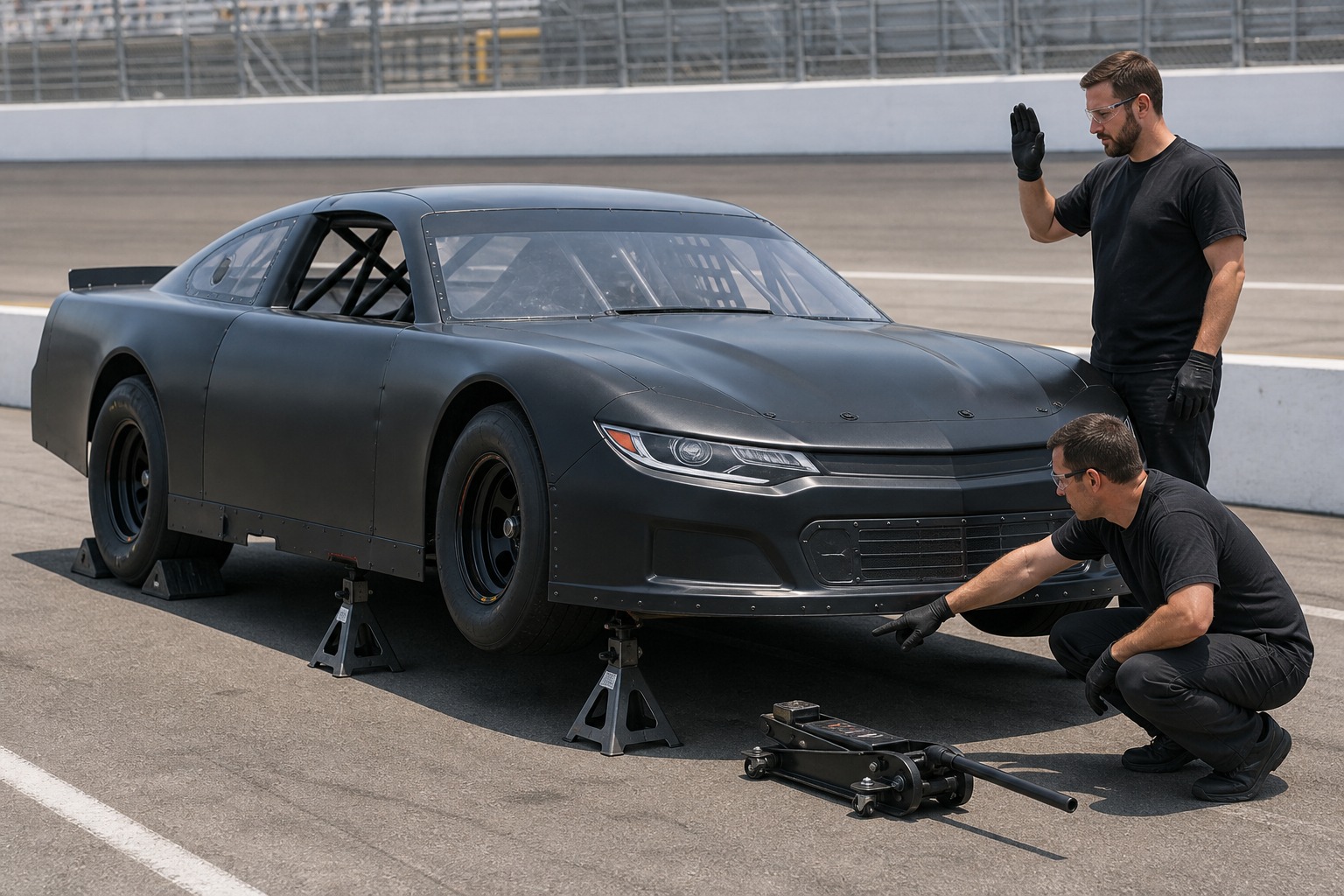
Make the support status visible before anyone reaches under
Start with one named lift lead. That person confirms the engine and controls are in the condition required by the car's service procedure, clears passengers and tools from the cockpit, and keeps the surrounding crew out of the lift zone. The lead uses the exact chassis and equipment instructions for lift points, stand locations and capacities. A familiar-looking frame rail is not proof that it is an approved support point.
The pit surface is part of the system. The car, jack, stands and wheel chocks need firm, level support that will not shift or sink. Cracked pavement, loose gravel, sloped ground or heat-softened asphalt changes the decision; a hurried pad placed under one foot does not automatically make an unstable surface safe. If the surface or approved support location is uncertain, the under-car job waits for a suitable work area.
After the car reaches the required height, place correctly rated rigid supports as directed for that chassis and lower the load onto them in a controlled way. The New York FACE vehicle-repair fact sheet archived by NIOSH tells workers to have vehicles properly jacked, supported with stands and chocked before anyone goes underneath, and to follow the manufacturer's lifting instructions. The floor jack never becomes the only thing between a crew member and the car.
The second crew member verifies without putting a head, arm or shoulder beneath the chassis. From outside the fall zone, that person checks the visible stand saddles, locking features, capacity markings, wheel chocks and contact with the ground. The check also confirms that nobody is seated in the car and that no tool cart, cable or hose can bump the jack or a stand. If any part of the support cannot be seen or understood, the status remains “no access.”
Only the lift lead announces that the car is supported for work. The phrase should describe the condition, not merely the action: the car is on its specified supports, movement is controlled, and the work area is clear. A nod from across a noisy pit is too easy to misread. The person who will work beneath the car repeats the status before crossing the sill line, so the handoff has a sender and a receiver.
Keep one status until the job is closed
Once under-car access begins, nobody changes the support system, enters the cockpit, starts the engine or moves the vehicle without stopping the job and beginning a new handoff. Parts removed during setup can also alter balance, so the original support plan is not automatically valid after a major component moves. The crew follows the chassis, jack and stand instructions rather than improvising around the next session's clock.
Equipment identity belongs in the pre-event check. A 2020 NHTSA advisory covered specific recalled jack-stand models that could collapse under load and explained how owners could identify them by item number. That specific jack-stand recall does not condemn every stand, but it shows why the crew records make, model, capacity and recall status instead of treating every pair of stands as interchangeable. Bent bases, damaged locks, unreadable labels or mismatched pairs stay out of service pending the equipment maker's guidance.
The closing handoff is just as deliberate. The person under the car comes fully clear and accounts for tools, lights and loose parts. The lift lead visually confirms the clear zone, tells the crew that the support state is changing, and follows the equipment procedure to take the load, remove supports and lower the car. Nobody reaches back beneath a descending car to retrieve a forgotten socket.
After the tires are back on the ground, the crew checks that the car is stable, that required fasteners and panels are complete, and that jacks, stands and chocks have left the travel path. Only then does the status change from maintenance to ready for the next track-specific inspection. If another under-car task appears, the process begins again rather than borrowing the previous all-clear.
A short-track turnaround rewards speed only when the crew shares the same picture of the car. The support-status handoff makes that picture explicit: who controls the lift, what independently supports the chassis, whether movement is prevented and when every person is clear. Losing one minute to that agreement is better than letting schedule pressure turn a raised car into an unverified hazard.