PIT COMMUNICATION BRIEF
Hearing Protection That Preserves Pit-Lane Communication at a Short Track
August 31, 2026
A loud pit lane does not leave room for improvised radio calls. The useful plan is to fit hearing protection, agree on a few exact messages, and move longer conversations away from running engines before the first practice lap.
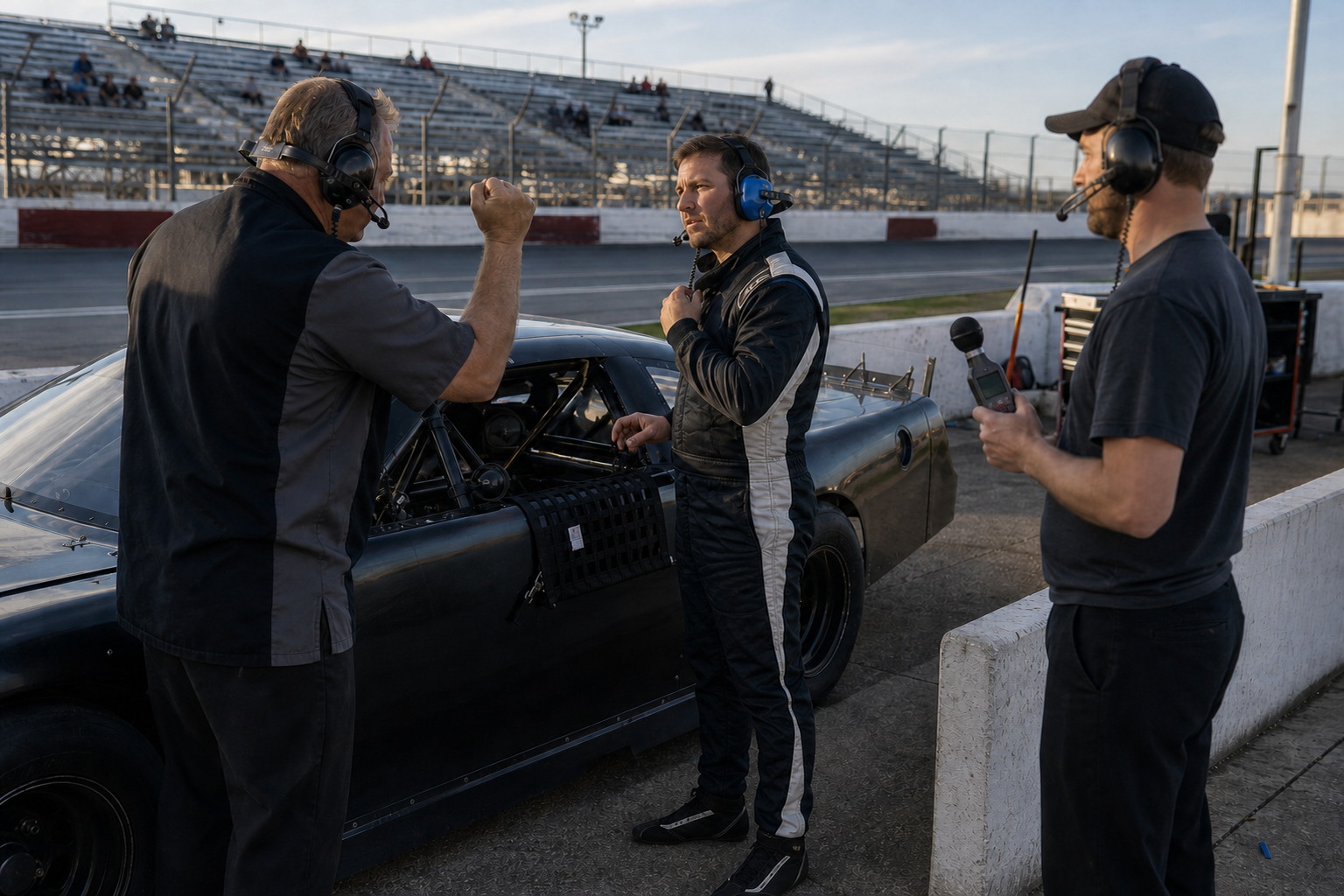
Short-track pits can expose a crew to intense noise during warm-up, practice and racing. In its stock-car research, NIOSH found the highest area levels in the pits, with peaks at or above 130 dB at the tracks studied. That evidence changes the briefing: hearing protection is not an accessory saved for the green flag, and a shouted sentence is not a dependable communication system.
The aim is not simply to make the pit quieter inside one person's headset. The crew needs enough protection for the exposure, a reliable way to hear critical words, and a separate place for discussions that do not belong beside a running race car. A five-minute rehearsal beside the parked car can expose weak radio batteries, a poor ear-seal, vague vocabulary or a hand signal that looks different from across the pit box.
Draw a working noise map before the engine starts
Begin with the places people actually stand. Mark the car-side work zone, the pit-wall or spotter position, the route to the staging lane, and one quieter place behind the active work area. The map does not need measured contours to be useful. It needs to answer who must stay near the car, who can step back, and where a crew member can receive a longer instruction without asking for it three times.
- Car-side zone
- Only the people needed for the immediate check remain here while the engine is running. Messages are short and already defined.
- Relay zone
- One designated crew member repeats the driver's or crew chief's instruction and confirms that the intended person received it.
- Quiet pocket
- Setup discussion, symptom descriptions and changes to the run plan move here after the car is secure.
This physical map keeps communication and exposure control in the same plan. It also makes the written track rules easier to apply because each crew member knows where a conversation or task should happen before cars begin moving through the lane.
Fit protection before testing the radio
Do not use a successful radio check to prove that a hearing protector fits. The order is the other way around: seat the earplugs or earmuffs correctly, confirm that the helmet, glasses and headset do not break the seal, and then test speech. The NIOSH hearing-protection guidance emphasizes fit, compatibility and communication; it also notes that communication headsets can help speech in very loud environments.
At the parked car, the driver puts on the same protection and communication equipment that will be used in the session. The crew chief stands at the real working distance, gives one normal call, and watches for the agreed hand signal. A third crew member checks the loud area with a sound-level meter as a screening aid, without treating a phone or single spot reading as a complete exposure assessment. If a person has to lift a muff or loosen an earplug to understand the call, the combination has failed the rehearsal.
Too little protection is dangerous, but indiscriminately blocking every sound can also interfere with awareness. Selection has to match the actual exposure and job. For a workplace context, the OSHA noise overview explains that raised-voice difficulty at close range is a warning sign and that meters or dosimeters are used to assess noise. The track should rely on its qualified safety process for measurements and requirements, while the crew uses the briefing to make correct use consistent.
Give every critical call a readback
A radio message should say what must happen, where it applies and when it is complete. Replace loose words such as “check it” with a stable phrase: “right-front pressure after cool-down,” “engine off before the hood opens,” or “hold position at the cone.” The receiver repeats the action, not merely “copy.” That short readback catches a wrong corner, an uncertain timing cue and a transmission clipped by engine noise.
Call: “Engine off, then right-front pressure.”
Readback: “Engine off first; right-front pressure next.”
Close: a raised closed fist confirms the car is secure.
The hand signal is a backup, not a second simultaneous instruction. Pick a small set that cannot be confused from the normal viewing angle: stop, hold, come closer slowly, and move to the quiet pocket. Rehearse them with the stock car parked, the driver seated and the crew chief in the position used during practice. If the driver's sight line is blocked by the window net, helmet opening or another crew member, change the sender's position rather than inventing a more complicated gesture.
Move long conversations away from running engines
Exposure is affected by both level and time. The NIOSH guidance on administrative controls recommends increasing distance, reducing exposure duration, moving unrelated tasks to quieter areas and using communication headsets with hearing protection for communication-intensive work. In a short-track pit, that translates into an operational rule: collect the immediate safety facts at the car, then move the diagnosis and setup debate to the quiet pocket.
Assign one person to carry the message so four people do not remain beside the exhaust while trying to reach the same conclusion. The relay member records the exact symptom, lap or phase of the run, and the decision made away from the car. When the crew returns, the work order is short enough to repeat in one breath. This also reduces the chance that two mechanics hear different versions and start incompatible jobs.
Close the session with one communication note
After practice, record more than whether the radio worked. Note where a call was missed, whether the driver removed or adjusted protection, which hand signal was unclear, and whether the quiet pocket was actually usable. A single missed phrase may point to a battery, connector, headset fit, wording or position problem; the note keeps the crew from guessing at the next event.
Review the communication note beside the technical run notes, then update only the part of the plan that failed. The latest race-operation briefs remain together in the Articles / News archive. A consistent sequence—noise map, fitted protection, radio readback, hand-signal backup and a quiet place for detail—lets the crew protect hearing without sacrificing the clear commands that keep a busy pit lane orderly.